
Sanctuary Mountain Maungatautari Tops Global Biodiversity Credit Sales
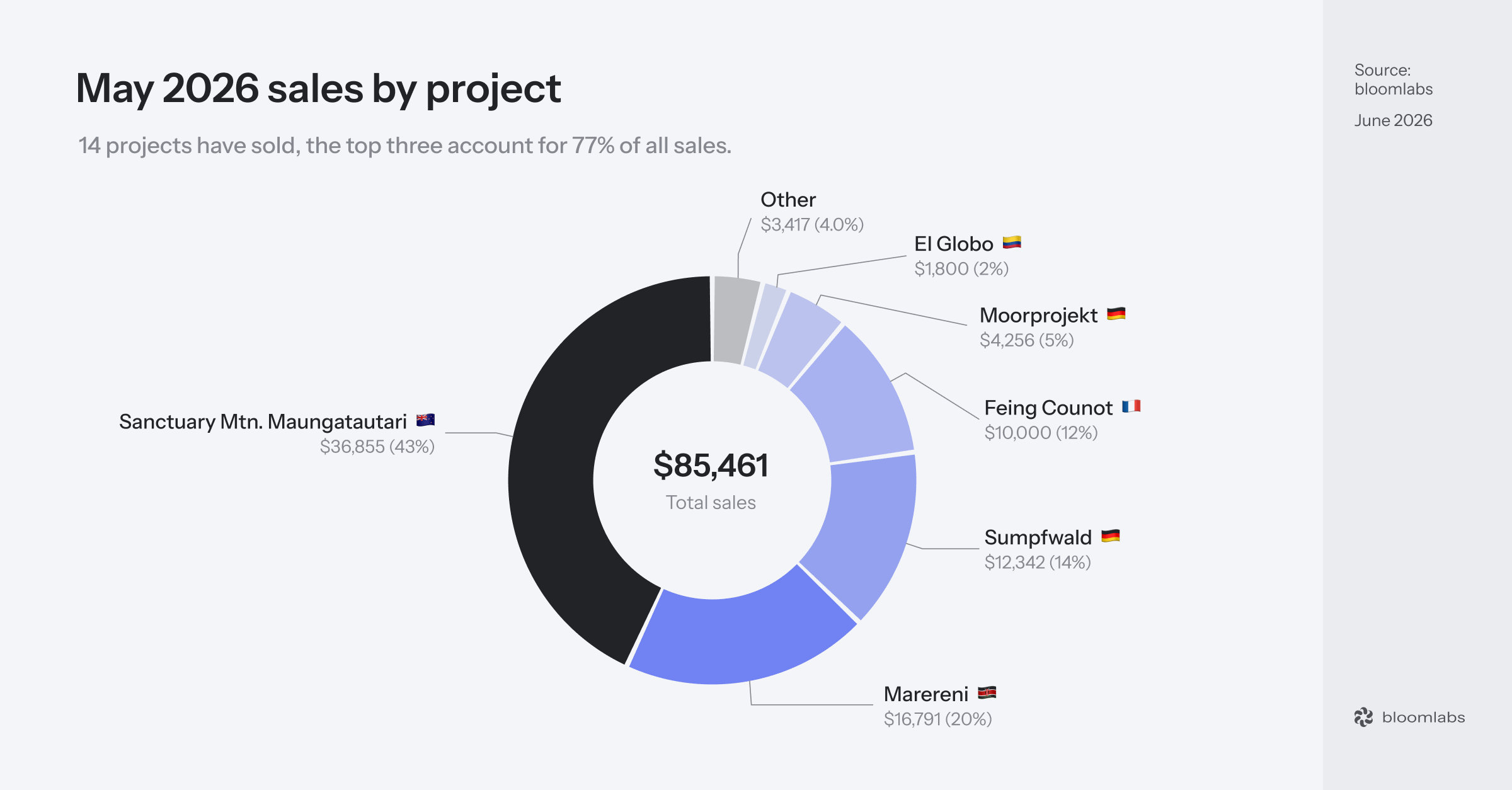
We recently received some exciting news. Bloomlabs’ latest Voluntary Biodiversity Market Overview confirmed that Sanctuary Mountain Maungatautari, our first verified BioCredita project, was the top-selling biodiversity credit project globally in May 2026, accounting for 43% of total worldwide biodiversity credit sales that month, outperforming 13 international projects across Europe, Africa, Australia, and the Americas.
The result was also picked up by Carbon News, which reported that Sanctuary Mountain recorded 23 transactions during May, generating $36,855 in sales. This marks a significant rise from late last year, when the programme ranked fourth globally for biodiversity credit sales volumes.
Perhaps most encouraging is where that demand is coming from. Perhaps most encouraging is where that demand is coming from. Almost all buyers of Sanctuary Mountain biodiversity credits were New Zealand organisations — Kiwi companies choosing to invest in verified conservation work right here in Aotearoa. Named buyers included Tonkin + Taylor, the New Zealand engineering and environmental consultancy, which made a returning purchase of $17,066 having first bought in 2025, and Picot Productions, makers of Pic’s Peanut Butter, which made its first purchase at $10,416. Other New Zealand buyers included the New Zealand Educational Institute, The Hello Cup Company, Kimi Ora Resort, Tourism Industry Aotearoa, and Origin Fire Consulting — representing a broad range of sectors from tourism and hospitality to education and professional services.
Ekos CEO Sean Weaver said the strong domestic demand demonstrated that high-integrity, community-based biodiversity projects could compete on the world stage while delivering meaningful local outcomes.
“This ‘local buyer, local project’ pattern is exactly the type of domestic market behaviour the New Zealand Government’s newly announced voluntary carbon and nature markets framework is designed to support. The demand we’re seeing is genuine, repeatable, and values-driven. Businesses want to invest in nature here at home — and they want credible, measurable outcomes.”
Bloomlabs’ analysis also noted that New Zealand had the most consequential month of any country they track, with both policy developments and market activity strengthening Aotearoa’s role in the nature finance sector.
Where biodiversity credits fit within the regulatory landscape
While the Ekos BioCredita programme sits outside the Government's Guidance for Voluntary Climate Change Mitigation, this is by design. As Sean explains:
“Biodiversity credits do not constitute climate change mitigation but instead focus on biodiversity conservation and the mitigation of biodiversity loss. Accordingly, the government's Voluntary Climate Change Mitigation criteria do not cover biodiversity credits.”
The Ekos SD Standard remains the only biodiversity credit programme globally to have been independently validated against the High-Level Principles developed by the Biodiversity Credit Alliance, the World Economic Forum, and the International Advisory Panel on Biodiversity Credits (BCA/WEF/IAPB).
Sean noted that while the Government’s agenda on voluntary nature markets includes both carbon and biodiversity markets, its current recognition framework focuses on carbon-related mechanisms. Ekos is actively contributing to the development of integrity guidelines for biodiversity markets through ongoing consultations with Ministry for the Environment officials.

How biodiversity credits are sold
Most biodiversity credits sold through the BioCredita programme are packaged alongside carbon credits, reflecting growing demand for broader environmental outcomes.
“The vast majority of our biodiversity credit sales are sold in bundles with carbon credits. The buyer wants, say, 500 carbon credits — so we sell them a bundle combining 500 carbon credits with biodiversity credits. Another option is to bundle biodiversity credits with compliance carbon credits for buyers who want to incorporate ESG reporting outputs through their carbon credit trades.”
In another significant milestone, Ekos recently completed the first international trade of biodiversity credits from a New Zealand project, with Sanctuary Mountain Maungatautari credits sold to Stradonia, a hotel in Poland, through the ClimateTrade platform. A Turkish company, Flamingo Technologies, also purchased Sanctuary Mountain credits during May, further demonstrating the project’s growing international profile.
With several more projects in the pipeline, including projects from New Zealand, Australia, USA, Mongolia, and Uganda, the momentum behind the Ekos BioCredita programme is only growing.
Huge thanks to Sanctuary Mountain Maungatautari, and to every business that has chosen to back the project through Ekos BioCredita. Together, we really are looking after this place.
Further reading
Carbon News: NZ biodiversity credits top global rankings
Bloomlabs: Monthly Market Overview May 2026
Ekos on LinkedIn: Our original announcement
Sean Weaver on LinkedIn: Commentary on the Carbon News article
Learn more about Ekos BioCredita