
Beyond carbon: what the new ISO/UNDP 53001 means for the next stage of organisational sustainability
For many organisations, measuring their carbon footprint has been the first meaningful step on the sustainability journey. It gives businesses visibility over greenhouse gas emissions, establishes a baseline and provides evidence to inform future climate action.
But increasingly, organisations are asking a bigger question:
What comes next?
Sustainability challenges do not exist in isolation. Climate change interacts with biodiversity and ecosystems, supply chains, resource use, communities, organisational resilience and business strategy. At the same time, expectations from customers, employees, procurement teams, regulators, investors and other stakeholders continue to evolve.
A recently published international standard provides an interesting indication of where sustainability management is heading.
Introducing ISO/UNDP 53001:2026
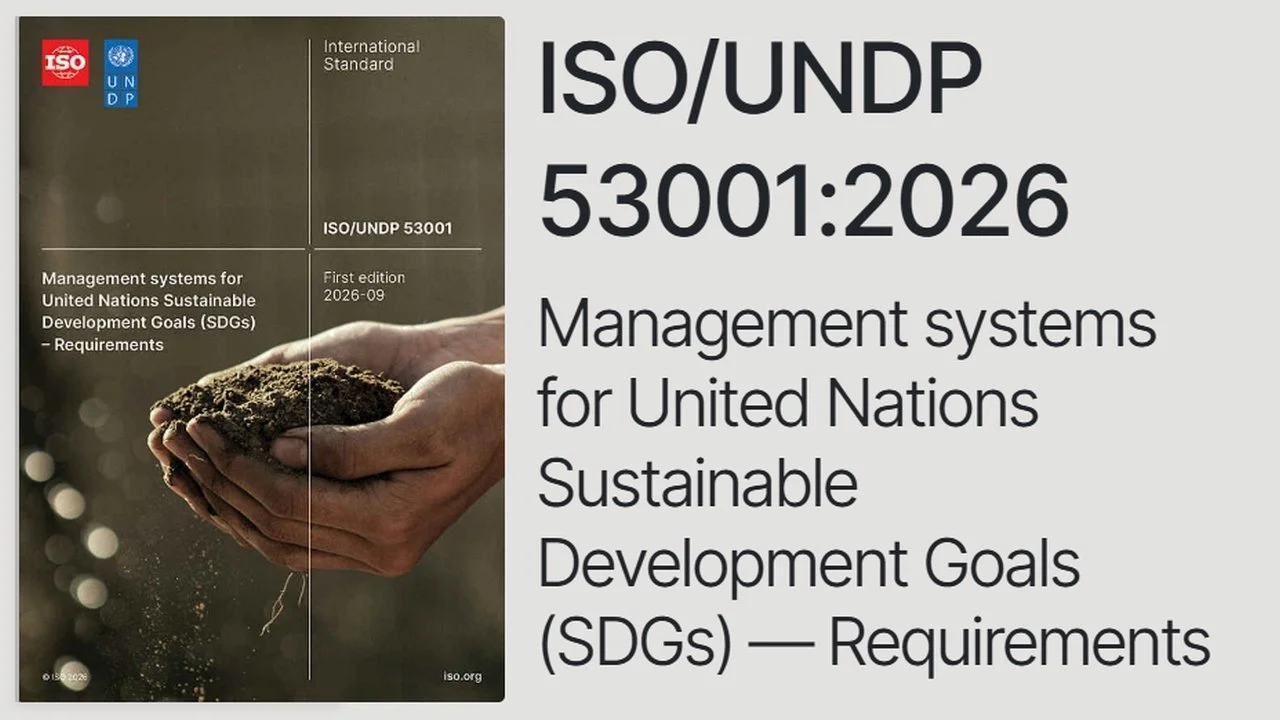
Published in September 2026, ISO/UNDP 53001:2026, Management systems for United Nations Sustainable Development Goals (SDGs) – Requirements, is the world’s first International Standard providing a management-system approach specifically for organisations seeking to manage their contribution to the UN Sustainable Development Goals.
Developed jointly by the International Organization for Standardization (ISO) and the United Nations Development Programme (UNDP), the standard is designed to help organisations embed sustainable development into their purpose, strategy, operations and decision-making, rather than treating sustainability as a separate programme or collection of projects.
Importantly, this isn’t simply about selecting some of the 17 SDGs and including their colourful icons in a sustainability report.
ISO explains that the standard helps organisations identify and assess beneficial and adverse impacts, engage relevant interested parties, establish meaningful SDG objectives, collect data and evaluate progress. It also asks organisations to consider connections, synergies and trade-offs between different SDGs rather than addressing each goal independently.
At its heart is a familiar principle: continual improvement.
The standard uses a Plan-Do-Check-Act approach, creating a cycle in which organisations identify priorities, take action, evaluate performance and continually improve their contribution to sustainable development.
From sustainability initiatives to sustainability management
This distinction matters.
Many organisations are already doing good mahi: measuring carbon emissions, improving waste management, supporting employees and communities, considering procurement impacts or investing in environmental initiatives.
The challenge can be connecting those activities.
Without an overarching framework, sustainability efforts can become reactive, project-driven or primarily focused on compliance. Organisations can also find themselves investing effort in initiatives without first determining whether those initiatives address their most significant impacts, risks or opportunities.
ISO/UNDP 53001 reflects a shift towards a more strategic approach.
Rather than asking only:
“What sustainability activities are we doing?”
Organisations can increasingly ask:
“Which sustainability issues are most material to our organisation and stakeholders, and how do we systematically manage them?”
This means understanding adverse as well as beneficial impacts, identifying relevant stakeholders, setting objectives and integrating the resulting priorities into organisational processes and decisions. These are core components of the new ISO management-system approach.
Carbon measurement remains important, but it can be a foundation rather than the destination
For organisations already measuring their greenhouse gas emissions, this evolution doesn’t mean abandoning carbon management.
Quite the opposite.
A carbon footprint establishes valuable disciplines around data collection, organisational boundaries, performance monitoring and accountability. It also helps an organisation understand one of its potentially important environmental impacts.
The opportunity is to build on that foundation.
For example, an organisation that currently measures its carbon footprint might begin considering questions such as:
What other environmental or social impacts are material to our organisation?
What does our business depend on, including natural resources, ecosystems, infrastructure, people and supply chains?
Which sustainability risks could affect our strategy or operations?
Where could sustainability create efficiencies, innovation, resilience or competitive advantage?
What expectations are we seeing from customers and procurement processes?
Which issues should leadership prioritise over the next one, three or five years?
How will we demonstrate meaningful progress?
Moving beyond carbon therefore doesn’t diminish the importance of carbon measurement. It puts carbon into a broader strategic context.
A similar evolution is happening at Ekos
This same direction of travel has helped shape the new Ekos Sustainable Pathway Certification.
The programme is designed for organisations wanting to move beyond standalone sustainability activities towards a structured process of identifying, prioritising and acting on their material sustainability risks, impacts, dependencies and opportunities.
There are some interesting parallels with the direction represented by ISO/UNDP 53001.
Both approaches recognise that sustainability is most effective when it moves beyond isolated projects and becomes connected with organisational priorities and decision-making. Both emphasise structured action, monitoring and continual improvement.
The Ekos Sustainable Pathway puts this into practice through:
Initial assessment of material sustainability risks, impacts, dependencies and opportunities.
A sustainability strategy workshop to establish organisational priorities and identify opportunities.
A Strategic Action Plan translating those priorities into practical activities.
Independent external review of the plan against the programme requirements.
An ongoing sustainability partnership supporting implementation and organisational capability.
Quarterly reporting to maintain visibility over actions, emerging risks, opportunities and progress.
Annual independent review of progress against the Strategic Action Plan.
The emphasis is deliberately on implementation and continuous improvement, rather than requiring every participating organisation to have already achieved a predetermined level of environmental performance.
This distinction is important. Sustainability transformation is rarely achieved through a single project or certification event. It is an organisational journey that develops as knowledge, capability, expectations and circumstances evolve.
Where ISO/UNDP 53001 and the Ekos Sustainable Pathway meet
The approaches are not the same certification, and participation in the Ekos Sustainable Pathway does not represent certification to ISO/UNDP 53001.
However, there are clear similarities in the management philosophy behind them.
| Emerging sustainability practice | ISO/UNDP 53001 | Ekos Sustainable Pathway |
|---|---|---|
| Move beyond isolated sustainability initiatives | Embeds sustainable development into strategy, operations and decision-making | Connects sustainable priorities with business decision-making |
| Understand impacts | Considers beneficial and adverse impacts | Assesses sustainability impacts alongside risks, dependencies and opportunities |
| Prioritise action | Establishes meaningful SDG objectives | Develops priorities through assessment and a strategy workshop |
| Turn strategy into implementation | Integrates objectives and action into organisational processes | Creates a Strategic Action Plan and supports implementation |
| Monitor progress | Collects data and evaluates performance | Provides quarterly progress reporting |
| Continually improve | Uses Plan-Do-Check-Act | Uses ongoing support and annual review to drive continuous improvement |
The ISO descriptions above reflect the published scope and features of ISO/UNDP 53001:2026; the Ekos descriptions are based on the Sustainable Pathway programme design.
From measuring impact to managing sustainability
Perhaps the most useful lesson from the arrival of ISO/UNDP 53001 is not that every organisation suddenly needs another ISO certification.
It is that the maturity of sustainability practice is changing.
Measuring carbon answers an essential question:
“What are our greenhouse gas emissions?”
A broader sustainability management approach starts answering:
“What are our most important sustainability impacts, dependencies, risks and opportunities, and what are we going to do about them?”
And ultimately:
“How can sustainability contribute to a stronger, more resilient and responsible organisation?”
For businesses that have already invested in carbon measurement, this represents a logical opportunity to build on the mahi already completed rather than starting again.
Carbon data can remain an important part of the picture. The next step is putting it alongside other sustainability considerations, identifying what is genuinely material to the organisation and using that understanding to develop a prioritised roadmap for action.
The next chapter of sustainability
The introduction of ISO/UNDP 53001:2026 sends a useful signal internationally: sustainability is increasingly being treated as something to manage systematically, not simply something to report on.
ISO describes the intent as moving organisations from simply aligning with the SDGs towards taking and optimising action, while improving accountability and enabling continual improvement.
For New Zealand organisations, that presents an opportunity.
Those already measuring carbon don’t need to discard the work they have done. Instead, they can use it as the foundation for the next stage of their sustainability journey: understanding the bigger picture, identifying material priorities and building sustainability progressively into organisational strategy and everyday decision-making.
At Ekos, that’s the philosophy behind our Sustainable Pathway Certification: recognising the mahi organisations have already started, while providing the structure, expertise and independent review needed to turn sustainability ambition into an ongoing programme of strategic action and continuous improvement.
Because sustainability isn’t a destination or a single certificate.
It’s a pathway.