
Adapting Land Management to a Changing World
Guest writer: Sam Lang - Farm Advisor & Head of Impact at Groundshift.
We are living through an uncertain, interesting and potentially pivotal time in the history of agriculture and land management in Aotearoa. It feels like we are at (or fast approaching) an inflection point where the vulnerabilities of our fossil-fuelled farming and food systems are being exposed and challenged - to the point where more people are questioning and looking for alternatives. So what are they?
I’ve spent the last decade farming and supporting other farmers pioneering alternative methods focused on low input, high diversity farm systems (that go by labels such as biological, regenerative, ecological, nature-based etc). Thanks to really active farmer-farmer knowledge sharing, the productivity and financial performance of these farm systems had steadily improved, with many of them now top industry performers in terms of both profitability and ecological health.
Most of these improvements are a result of focusing on soil health, pasture diversity, grazing management, animal nutrition and decision making. These are core focus areas of our education and advisory work at Groundshift. However pioneering farmers are now actively looking to the next opportunity to level-up their farm performance and resilience - agroforestry.
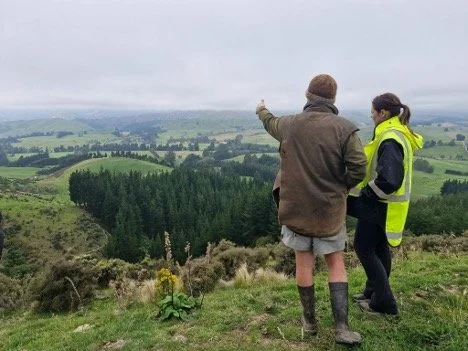
Farmer Mark Koopmans and Grace from Ekos Forever Forests discussing which land is best suited to plantation forestry vs native regeneration.
Agroforestry is a broad term. We are working with farmers at the moment on high level concept plans for integrating production forestry, native regeneration, native planting, mixed exotic and native permanent forestry and continuous cover forestry - it’s horses for courses. Working with the Ekos Forever Forests team is a fantastic partnership where they bring broad expertise and operational skills for forestry and carbon management, while we (Groundshift) bring farm system knowledge and business insights.
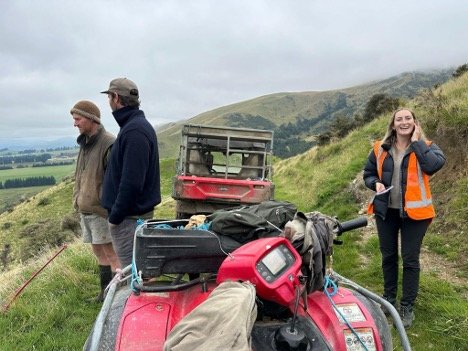
Aimee Hyland (Ekos Forever Forests) with Sam Lang (Groundshift) and farmer Mark Koopmans scoping potential production forestry and native regeneration carbon projects.
I’m more of a ‘grass man’ than a ‘tree man’ - I don’t want to see productive farmland retired for carbon sequestration and I don’t think we need to. However it’s clear that most of our farming landscapes need more trees, and there are huge areas of hill country farmland in particular that could benefit economically and ecologically from either full afforestation or at least space planting. The early revenue from carbon and potentially biodiversity credits is a unique opportunity to achieve this land use optimisation for typically cash-poor farming businesses.
We are also innovating in less traditional designs such as diverse multifunctional shelterbelts, silvopasture, space plantings and ‘keyline’ layouts. These systems can bring a wide range of benefits including livestock shade/shelter, erosion stabilisation, nutrient cycling, water retention, livestock fodder/browse, habitat for birds & insects, aesthetics and of course carbon sequestration. Well designed, they deliver their ROI through reduced input costs, higher pasture quality, better animal performance and improved drought and flood resilience. They’re usually not eligible for ETS carbon credits under current rules, but there are ways to link them up… and perhaps with a mix of effort and luck we might score a rule change to make them eligible.
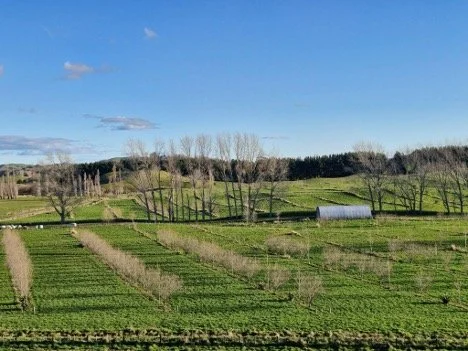
ETS eligible ‘silvopasture’ rows at Mangarara Station in Hawke’s Bay at 20m spacings (photo: Sam Lang).
If you want to explore your options for adapting your land use and management to our changing world, reach out to the team at Ekos Forever Forests or Groundshift.
About Sam Lang:
Co-Founder, Advisor and Head of Impact at Groundshift - sam.lang@groundshift.ag
Co-author of ‘Ecological Agriculture: Our Biggest Climate Opportunity’ in Kiwis in Climate: Voices for Solutions.